
JNIM’s Push Toward Guinea: Is the Threat Moving from Southern Mali to the Gulf of Guinea States?
A special investigation into signs that Jama’at Nusrat al-Islam wal-Muslimin (JNIM) is expanding from southern Mali toward Guinea’s border areas, separating confirmed facts from indicators that still need to be proven.

Special investigation | Al-Sahel News
Prepared by: Investigations and Security Analysis Desk
Location: Mali–Guinea border area
Category: Regional security analysis
Introduction: a cross-border threat raising concern
Security concerns are growing in West Africa that the activity of armed groups linked to al-Qaeda could spread from southern Mali to neighbouring countries, first among them Guinea, which shares with Mali a border marked by forests and rural roads that are hard to monitor continuously.
Jama’at Nusrat al-Islam wal-Muslimin (JNIM) stands out as one of the main armed actors in the Sahel, active inside Mali and in other parts of West Africa. Information in circulating reports on the border security situation points to a possible effort by elements linked to the group to extend their movements toward Guinean territory.
Distinguishing between confirmed operational expansion, limited movements and mere possible intelligence indicators nonetheless remains essential to understand the real threat and gauge its scale, without exaggeration or unproven conclusions.
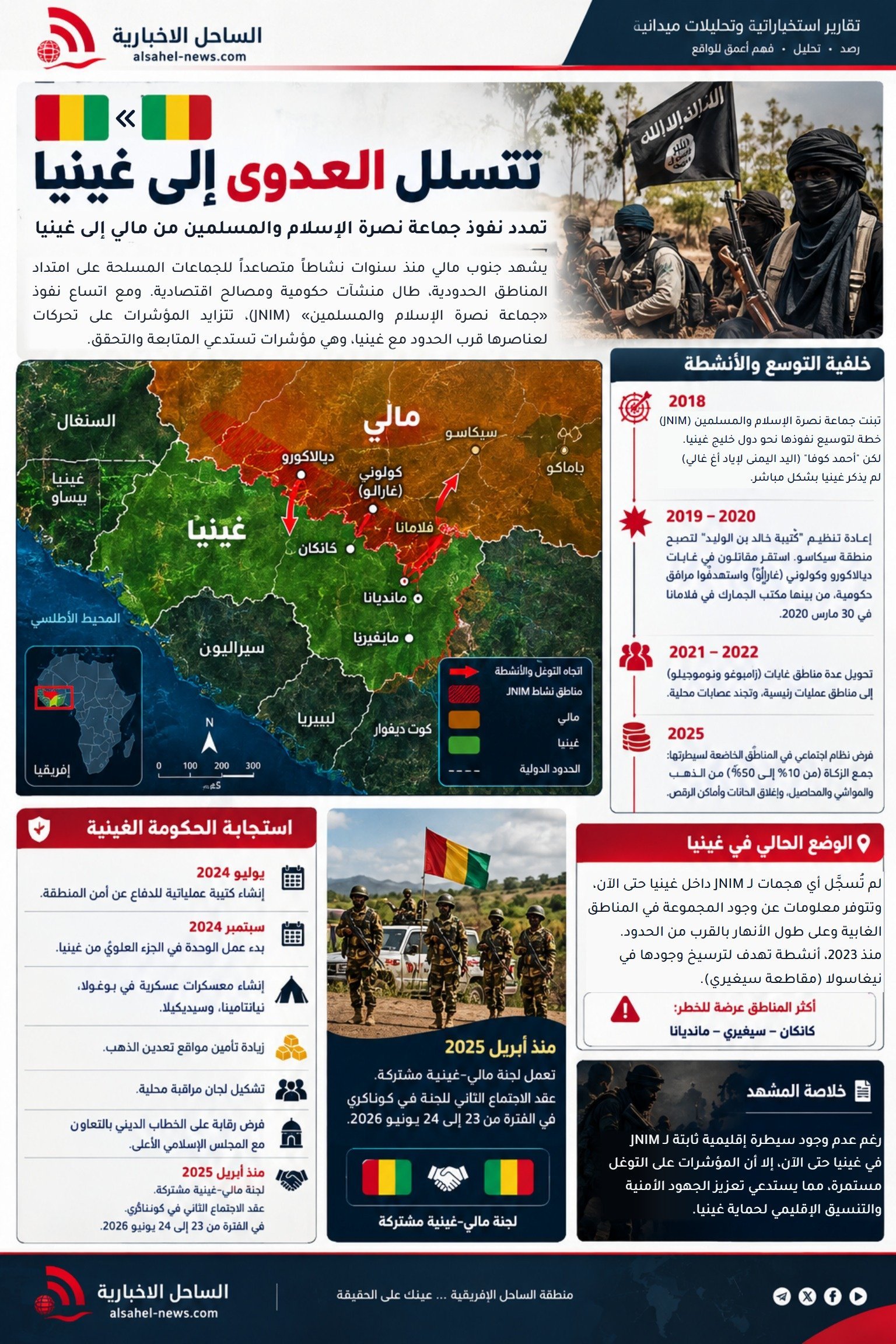
1. From southern Mali to the border areas
Southern Mali has seen growing activity by armed groups in recent years, including attacks on government and security facilities and attempts to extend their influence in some rural and forested areas.
The information in the account under analysis indicates that armed-group activity around the Sikasso region went through successive developments between 2018 and 2022, including the reorganisation of armed units, wider movements in forested areas and attempts to recruit local members.
The places mentioned in this context include Dialakoro and Koloni, linked to Garalo, as well as Falamana, where a customs office was attacked on 30 March 2020, according to the initial material. Confirming the details of this incident and who was responsible requires independent, reliable records.
These areas matter because of their location and their links to rural and border corridors, which makes them relevant to assessing how armed groups move and how able they are to shift between areas of activity.
2. Guinea within the range of a possible threat
The most sensitive question is whether some of the group’s activity could move from Malian territory into Guinea’s border areas, especially where forests, villages and local paths overlap.
According to the information received, the Niagassola area in the Siguiri prefecture has shown, since 2023, indicators said to be linked to attempts to establish a presence of militant elements or to build local networks.
These indicators alone, however, do not prove that the group has a stable organisational structure inside Guinea, nor that it has imposed territorial control or opened a permanent operational front.
According to the material under analysis, no confirmed attacks attributed to JNIM have been recorded inside Guinea in the period covered by this information. This point still needs to be checked against independent security and news sources before it is treated as a final assessment.
3. Which areas are most at risk?
The initial data place three Guinean areas within the scope of security attention because of their location and proximity to the Malian border:
- Kankan: an important area in eastern Guinea, whose location calls for close monitoring of security developments coming from the Malian side.
- Siguiri: particularly important in this assessment, given its proximity to the border and its links to mining areas and rural activities.
- Mandiana: another border area where the movement of people, irregular activities and security developments in its surroundings need to be followed.
Listing these areas as at risk does not mean they are under the group’s influence or that confirmed armed activity is taking place there. An accurate assessment requires documented field evidence, official data and independent information on the nature, location and timing of incidents.
Mining areas carry additional weight in this context: mobile economic activities and local trade networks can be affected by insecurity, and some economic sites could become exposed to extortion or attacks if armed groups manage to reach them.
4. Imposing social and economic influence in areas of activity
JNIM’s impact where it operates is not limited to armed operations. Reports on jihadist groups in the Sahel point to attempts to impose social rules and to collect levies from residents and economic activities in some areas under their influence.
The initial material includes claims that levies were imposed on mined gold, livestock and crops, along with restrictions on some commercial and social activities in parts of Mali during 2025.
The specific levy rates cited in the original account, ranging from 10% to 50%, require independent documentation specifying the area, the period and the activity concerned; these rates cannot be generalised to all areas or activities without evidence.
If such practices were shown to have reached Guinean territory, the risks would go beyond direct security to affect livelihoods, freedom of economic activity, the safety of mining workers and the ability of local authorities to provide basic services.
5. Guinea’s response to the risks
Facing a possible threat from across the border, the initial information describes measures that the Guinean authorities reportedly took to strengthen the security presence in the eastern and north-eastern regions.
According to this account, the measures include setting up an operational unit responsible for the area’s security in July 2024, which began operating in Upper Guinea in September of the same year.
The material also mentions military posts set up in Bougoula, Niantanina and Sidikila, stronger protection of gold-mining sites, local monitoring committees, and measures to follow religious discourse in cooperation with the High Islamic Council.
The details of these measures, where the military units are deployed and what they are responsible for need confirmation from independent Guinean government sources. Any measures involving religious institutions should also respect freedom of belief and the law, and the fight against extremism must not turn into blanket suspicion of local communities.
In the end, an effective security response depends on combining border protection, information sharing, a stronger presence of state institutions and action on the social and economic conditions that armed groups may exploit to recruit.
6. Mali–Guinea cooperation: a need beyond borders
Cooperation between Mali and Guinea is an important factor in dealing with shared security risks, especially since armed movements and financing and smuggling networks do not necessarily stop at political borders.
According to the initial material, a joint committee of the two countries began work in April 2025, and its second meeting was held in Conakry on 23 and 24 June 2026.
If official statements confirm these details, the committee’s continued work could provide a framework to coordinate security efforts, share information on border incidents, discuss joint response mechanisms and strengthen contacts between local authorities in the border areas.
The success of this cooperation, however, is not measured by the number of meetings but by tangible results, such as better early warning, faster verification of incidents, preventing violence from reaching civilian areas and keeping trade and services running safely.
7. What we know, and what still needs to be proven
A professional assessment requires separating three main questions:
First: armed activity in Mali.
JNIM is one of the most significant armed threats in the Sahel, and its activity in Mali is an important basis for understanding regional risks.
Second: possible expansion toward Guinea.
The reported indicators of possible movements near the Guinean border deserve monitoring and verification, but on their own they do not prove a stable organisation inside the country or a shift of its centre of operations there.
Third: the level of direct threat.
Neither territorial control by the group inside Guinea nor attacks by it there can be asserted on the basis of the initial information alone. That requires reviewing statements by the Guinean authorities, independent reports and the evidence for each incident.
Separating facts, indicators and conclusions in this way is necessary to avoid inflating the risks, and it helps direct security resources to the areas and activities that genuinely need attention.
Final assessment: a risk worth watching, without getting ahead of the evidence
The data presented show how important it is to monitor security developments in southern Mali and along the border with Guinea, given the ability of Sahel armed groups to exploit rural spaces and weak oversight in some areas to expand their activity.
Moving from a regional threat to proof of an actual, stable penetration of Guinean territory, however, requires more specific and reliable evidence. Until such evidence is available, the most accurate description is that Guinea faces potential security risks that call for vigilance and cross-border cooperation, without asserting that the group has established a stable front inside the country.
The priority for the authorities concerned remains protecting civilians and economic sites, improving coordination between neighbouring states, supporting local communities and quickly verifying circulating information. Dealing effectively with cross-border threats starts with accurate information, not assumptions.
Al-Sahel News | Strategic reports and analysis
Source: analysis of information received on the security situation in southern Mali and the border areas with Guinea.


Comments (0)